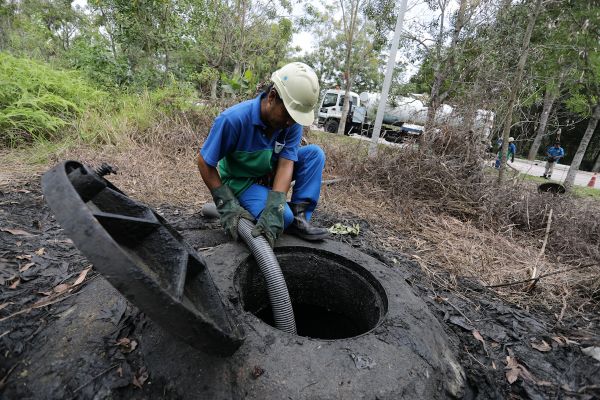

BANGI, March 26 — The Royal Malaysia Police (PDRM) is now leveraging drug residue analysis in sewage systems to detect the presence of drug laboratories in any particular area.
Deputy Inspector-General of Police Datuk Seri Ayob Khan Mydin Pitchay said this approach could also identify new types of drugs being used in the country and determine whether they originate domestically or from abroad.
“This initiative is still in its early stage. Through this method, for instance, we can identify the residential area involved and then follow up with the intelligence division to locate the drug laboratory.
“It will be a tremendous help because, previously, we were unsure about where to set the target. With this data, follow-up actions, including operations, will be more streamlined,” he told a press conference after the launch of the Tims-tof device at the Universiti Kebangsaan Malaysia (UKM) Faculty of Health Sciences today.
Ayob Khan said that so far, sewage water analysis in Lembah Subang has detected the presence of methamphetamine and fentanyl, indicating the potential existence of drug-processing laboratories in the area.
“We have only collected sewage residue samples from Klang Valley and Johor so far. We haven’t yet expanded to nationwide coverage,” he said.
Ayob Khan said the feasibility of this innovative approach stems from collaborative efforts in forensic science established between the Narcotics Criminal Investigation Department and UKM since 2022.
He explained that the collaboration with UKM focuses on scientific research concerning prohibited substances, including new psychoactive substances and efforts to curb the illegal production of drugs within the country.
He said that through this partnership, which secured funding of RM 8.4 million from the Home Ministry, six work packages have been outlined, encompassing aspects such as technology development, research, forensics, data management, and capacity building.
“As of now, RM2.4 million has been disbursed,” he said.
Meanwhile, Ayob Khan said the use of the Tims-tof device significantly enhances drug detection efficiency in urine samples as the process now takes only 20 seconds compared to two days previously, enabling the identification of a wider range of chemical substances, including over 1,000 compounds listed by the United Nations Office on Drugs and Crime.
“From the tested samples alone, we managed to detect 57 types of drugs in a single sample, showing the diverse chemical substances used in drug production,” he explained.
Following this, efforts are underway to incorporate new substances into the schedules under the Poisons Act 1952 to streamline prosecution tasks, he added.
— Bernama